
Many patients today are interested in alternatives to the permanent meshes traditionally used in hernia surgery.
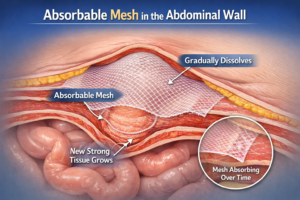
Although traditional meshes are safe and have helped millions of patients worldwide, advances in minimally invasive surgery and modern surgical materials now make it possible to offer safe, scientifically supported alternatives that may be appropriate for some patients in carefully selected situations with advanced minimally invasive options for hernia repair without permanent mesh, These include:
1. Advanced Suture Repair
Duramesh is a specialized suture system that functions like a flexible micro-mesh, distributing tension across the tissue.
• Strong closure of the defect
• Even distribution of tension
• Avoidance of permanent implants
It may be an excellent option for umbilical hernias, epigastric hernias, and some small to medium ventral hernias.
2. Fully Absorbable Meshes
Some modern meshes are designed to gradually disappear over 18–36 months, while stimulating the body to develop reinforcing tissue.
These meshes provide temporary support while are absorbed over time leaving behind reinforced scar tissue from the patient’s own body
3. Robotic Abdominal Wall Reconstruction
Robotic surgery allows for, precise anatomical reconstruction, minimally invasive surgery, faster recovery, less postoperative pain.
These advanced techniques allow surgeons to apply strategies that avoid permanent mesh in carefully selected cases.
Experto en Hernias
Dr. Héctor Valenzuela is a surgeon specialized in advanced abdominal wall surgery and robotic surgery, with extensive experience in modern hernia repair techniques.
His practice focuses on:
• Comprehensive treatment of abdominal wall conditions
• Robotic and laparoscopic hernia surgery
• Extraperitoneal surgical techniques
• Personalized treatment options for every patient
Patients from Mexico, the United States, Canada, and across Latin America travel to receive specialized treatment.
Medical Tourism is welcomed
Hernia Surgery for International Patients
Many international patients choose Guadalajara because of:
• Modern high-specialty hospitals https://share.google/vFK0EuZ4T0zjRdWC5
• Significantly lower costs compared to the United States
• Access to highly specialized surgeons
• Recovery in a safe and culturally vibrant city
We provide support for patients traveling from other countries.
Cost Comparison
United States: $18,000 – $40,000. Mexico: $6,000 – $10,000
https://doctorherniamx.com/contacto/
1. Is it possible to repair a hernia without using permanent mesh?
Yes, in selected patients it is possible, there are modern alternatives that may be appropriate for certain patients. The most important thing is choosing the safest and most durable solution for each individual patient.
2. Are permanent meshes dangerous?
Not necessarily.
Permanent meshes have helped millions of patients around the world and remain a very valuable tool in hernia surgery. However, some patients prefer to avoid permanent implants in their bodies or may have had previous concerns or negative experiences.
My goal is always to find the safest and most reliable solution for your specific situation.
3. What is mesh suture and how does it work?
Duramesh is a specialized surgical suture designed to function somewhat like a flexible micro-mesh. Unlike a traditional suture, Duramesh distributes tension along the tissue, allowing the hernia defect to be closed in a stronger and more stable way.
Not every case is a candidate, but it can be an excellent option for certain types of hernias.
4. What are absorbable meshes?
Absorbable meshes are materials designed to provide temporary support to the tissue while it heals, and then gradually dissolve over time. These meshes typically remain in the body for approximately 18 to 36 months, during which they reinforce the repair while your own tissue strengthens.
Over time the material is absorbed, leaving your own reinforced scar tissue supporting the repair.
5. Who is a candidate for hernia repair without permanent mesh?
This depends on several factors, including: the size of the hernia, tissue quality, previous surgeries, presence of rectus diastasis and type and location of the hernia.
Smaller or medium-sized hernias often have more options for repair without permanent mesh.
During your consultation we carefully evaluate these factors to determine the safest approach.
6. Does robotic surgery help with these types of repairs?
Yes, it can help significantly.
Robotic surgery allows surgeons to perform more precise abdominal wall reconstruction, using high-definition 3-dimensional visualization and extremely precise instrument control. In my practice we use robotic surgery whenever it provides clear advantages for the patient.
7. What is the risk that the hernia could come back?
All hernia repairs carry some risk of recurrence, regardless of the technique used.
The most important factors include:
• Selecting the correct technique
• Performing a strong repair
• Optimizing patient-related risk factors
When the appropriate technique is selected for each patient, outcomes can be very good and long-lasting.
My approach is always tailored for each case providing balance, durability, safety.
8. Is recovery different if permanent mesh is not used?
In most cases, recovery is very similar, especially when minimally invasive or robotic techniques are used.
Most patients are able to:
• Walk the same day
• Go home shortly after surgery
• Resume light activities within a few days
9. Can I travel to have surgery with you?
Yes. Many of our patients travel from other cities and countries.
Before any surgery we usually begin with a virtual consultation, where we review:
• Medical history. • Imaging studies • Details about your hernia.